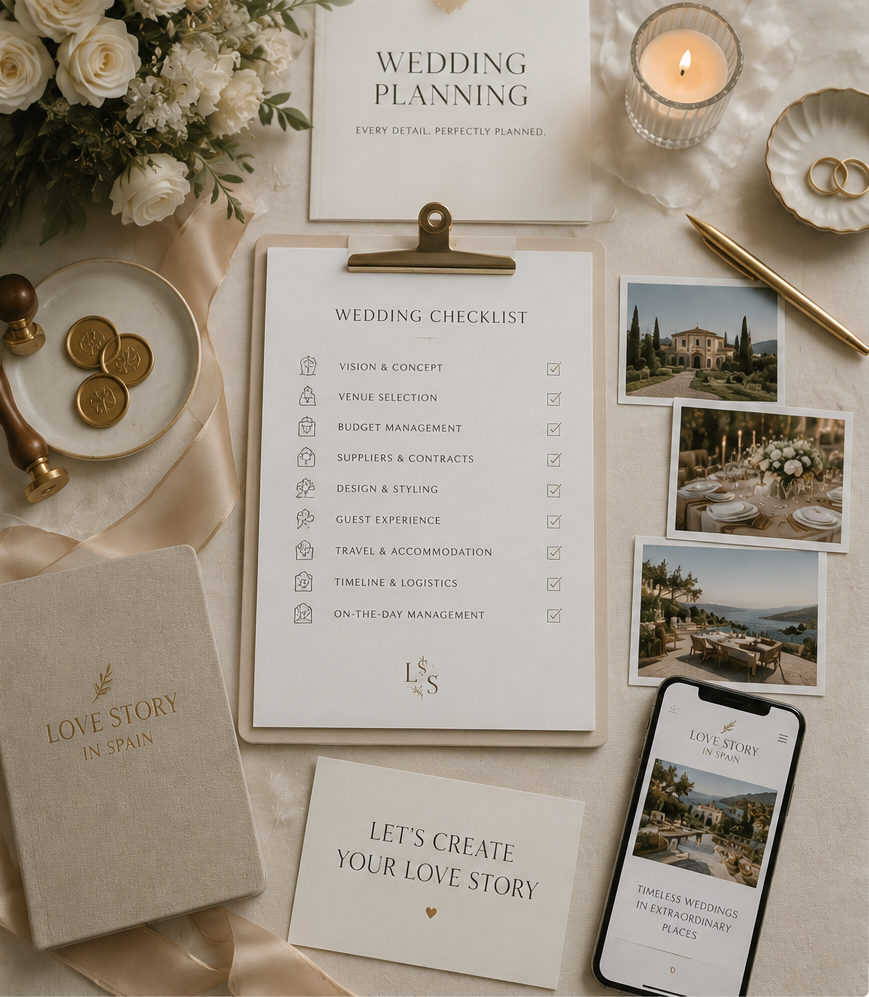
{$te}
Planning a destination wedding should feel exciting.
You are choosing a meaningful place, imagining several unforgettable days with the people you love and creating an experience that could never be reproduced in a conventional wedding venue close to home.
Yet somewhere between the first saved photograph and the final guest transfer, excitement can turn into pressure.
There are venues to compare, contracts to understand, suppliers to contact, budgets to control, guests to accommodate and hundreds of decisions that often need to be made in a language and country you may not know well.
The answer is not to remove yourself from the planning process completely. It is to make sure you are only involved in the decisions that truly need you.
Here are the ten essential steps for planning a destination wedding with clarity, confidence and far less stress.
1. Begin With the Experience, Not the Details
Before choosing flowers, invitations or table settings, decide how you want the wedding to feel.
Do you imagine an intimate dinner in a private villa?
A celebration at a historic Spanish finca?
A ceremony overlooking the sea followed by dancing beneath the stars?
Or a complete wedding weekend with a welcome dinner, the main celebration and a relaxed brunch the following day?
Begin with three questions:
- How do we want to feel during our wedding?
- How do we want our guests to feel?
- Which moments matter most to us?
Your answers become the foundation of every later decision.
Without this foundation, it is easy to become distracted by trends, opinions and beautiful ideas that do not belong to the same story.
A planner helps turn an emotional vision into a practical concept. Instead of simply collecting inspiration, they identify which venue, schedule, design and supplier team can make that vision possible.
2. Create a Realistic Budget From the Beginning
A destination wedding budget is not simply the amount you are willing to spend on the wedding day.
It may also include:
- Venue hire
- Catering and drinks
- Wedding planning and coordination
- Flowers and decoration
- Furniture, tableware and linen
- Photography and videography
- Music and entertainment
- Lighting and technical production
- Guest transportation
- Accommodation
- Welcome events and post-wedding activities
- Legal paperwork
- Travel costs
- Taxes and service charges
- A contingency fund
The earlier the budget is defined, the easier it becomes to protect it.
A good wedding planner will not simply tell you what everything costs. They will help you understand where the budget will create the greatest impact and where unnecessary spending can be avoided.
They also compare proposals correctly.
One venue may appear cheaper until furniture, catering, electricity, security and transport are added. Another may have a higher hire fee but already include much of the required infrastructure.
The lowest initial price is not always the best value.
3. Prepare an Honest Guest List
Your guest count affects almost every major decision.
It determines the size of the venue, catering costs, transport requirements, accommodation options, furniture quantities and the overall atmosphere of the celebration.
Before contacting venues, create three groups:
- Guests who must be there
- Guests you would genuinely love to invite
- Guests you feel expected to invite
This does not mean the final list must be decided immediately. It gives you a realistic range.
For a destination wedding, also consider whether the location and travel requirements will be manageable for older relatives, families with children and guests with limited mobility.
A planner can help you evaluate the guest experience before a venue is booked, not after problems appear.
4. Choose the Destination and Venue Carefully
A venue should be more than beautiful.
It must work.
When considering a wedding venue abroad, look beyond the photographs and ask:
- How far is it from the nearest international airport?
- Are there direct flights from the cities where most guests live?
- Is there enough accommodation nearby?
- Can the venue be used exclusively?
- What is the seated capacity?
- Is outdoor music permitted?
- Until what time can the celebration continue?
- Is catering included?
- Which furniture and equipment are provided?
- Is there a complete and attractive weather alternative?
- Are transfers and supplier access practical?
- Are there additional taxes, licence fees or minimum stays?
A local wedding agency understands which questions need to be asked before a contract is signed.
It can also introduce venues that may not appear in international searches but are better suited to your guest count, budget or preferred atmosphere.
The right venue should support your wedding rather than create a series of compromises.
5. Build One Trusted Supplier Team
A destination wedding may involve a planner, venue, caterer, florist, photographer, videographer, musicians, production company, transport provider, hair and makeup artists, rental company and accommodation partners.
Each supplier may be excellent individually.
The challenge is making them work as one team.
Someone needs to confirm:
- What each supplier is providing
- When they can access the venue
- Where they will set up
- What technical support they require
- Who is responsible for each transition
- How final payments will be handled
- What happens if the plan changes
Without central coordination, these questions often return to the couple.
A wedding planner becomes the single point of communication. They translate your decisions into clear instructions, follow up with suppliers and identify gaps before they become emergencies.
You should not spend the weeks before your wedding answering operational questions from ten different companies.
6. Plan the Guest Journey, Not Only the Ceremony
A destination wedding begins before the couple walks down the aisle.
For guests, it may begin when they receive the save-the-date, search for flights or decide where to stay.
A thoughtful guest experience can include:
- A clear wedding website
- Travel and airport information
- Recommended accommodation
- Transfer arrangements
- Dress-code guidance
- Local restaurant and activity recommendations
- A welcome note or gift
- Multilingual assistance
- A contact person for questions
- A schedule for the entire wedding weekend
This does not mean planning every minute of your guests’ trip.
It means removing uncertainty.
Guests should know where they need to be, how they will get there and what they can expect.
When this information is organised professionally, the couple receives fewer repeated questions and can remain emotionally present.
7. Create a Plan B You Actually Like
Every outdoor wedding needs an alternative plan.
A good Plan B is not simply a room that technically fits the guests. It should preserve the atmosphere, comfort and quality of the celebration.
Consider:
- Rain
- Strong wind
- Extreme heat
- Lower evening temperatures
- Changes to ceremony location
- Protection for musicians and technical equipment
- Alternative cocktail and dinner layouts
- Changes to lighting or decoration
- Guest movement between spaces
The best weather plan is created early enough to influence the design.
Flowers, furniture and lighting can then be selected to work in both settings. Suppliers know what will change, and the decision can be made calmly rather than under pressure.
The purpose of a weather plan is not to expect something to go wrong.
It is to make sure that nothing can take the wedding away from you.
8. Build a Detailed Wedding-Day Timeline
A wedding timeline is not only a list of ceremony, dinner and dancing times.
It should also include:
- Supplier arrivals
- Venue access
- Furniture installation
- Hair and makeup
- Photography preparations
- Guest transfers
- Ceremony seating
- Sound checks
- Catering service
- Speeches
- Entertainment
- Lighting changes
- Room transitions
- Late-night food
- Final transport
- Supplier collection and dismantling
Each part affects another.
If the ceremony begins later, golden-hour photographs may be lost. If dinner service takes longer than expected, the band may start late. If buses leave too early, guests may miss the final moments.
A professional planner creates a master timeline and makes sure every supplier understands their role within it.
On the wedding day, the couple should not know that a delivery arrived late or that a microphone had to be replaced.
They should simply experience a celebration that flows naturally.
9. Understand the Difference Between Planning and Coordination
Some couples assume that their venue coordinator will organise the entire wedding.
A venue coordinator usually represents the venue. Their responsibilities may include the property, internal catering, accommodation or venue rules.
A wedding planner represents the couple.
They coordinate the complete celebration across all venues, suppliers and events. They protect the concept, budget, timeline and guest experience from the beginning of planning until the final guest leaves.
Full wedding planning may include:
- Venue research
- Budget development
- Supplier selection
- Contract review
- Design and styling
- Guest logistics
- Menu planning
- Accommodation
- Transport
- Wedding-weekend events
- Timeline creation
- Supplier management
- On-the-day coordination
On-the-day coordination begins much later and is most suitable for couples who have already planned everything themselves.
For a destination wedding, full planning is often the more secure option because so many decisions depend on local knowledge and continuous communication.
10. Protect Your Experience as a Couple
A wedding can be beautifully organised and still become emotionally exhausting if the couple remains responsible for every detail.
The final weeks should not be filled with supplier reminders, seating-plan revisions, transport confirmations and questions about extension cables.
Your role is to make personal decisions:
- The people you want beside you
- The ceremony that feels true
- The food you want to share
- The music that means something
- The atmosphere you want to create
The planner’s role is to protect those decisions and make them possible.
Support is not about losing control.
It is about gaining the freedom to enjoy what you have created.
What Does a Wedding Planner Take Off Your Shoulders?
A reliable wedding planner becomes your researcher, organiser, negotiator, translator, problem-solver and calm point of contact.
They help you avoid unsuitable venues, unclear contracts, unrealistic schedules and disconnected supplier decisions.
They also take responsibility for the details that couples should never have to manage on their wedding day:
- Calling a delayed driver
- Adjusting the timeline
- Confirming dietary requirements
- Moving the ceremony because of weather
- Directing suppliers
- Solving technical issues
- Answering guest questions
- Checking every table before dinner
- Making sure the final transfer leaves safely
The greatest value of a planner is not that nothing unexpected will ever happen.
It is that when something changes, you may never need to know.
When Should You Hire a Destination Wedding Planner?
Ideally, hire your planner before choosing the venue.
The venue influences the budget, supplier options, accommodation, transport, weather plan and overall structure of the wedding. Professional advice at this stage can prevent expensive mistakes.
A planner is particularly valuable when:
- You are getting married in another country
- You do not speak the local language fluently
- You have limited time for planning
- Your guests are travelling from several countries
- You are organising multiple wedding events
- You want an outdoor wedding
- You need help controlling the budget
- You want a highly personalised design
- You would prefer not to manage suppliers yourself
- You want to be fully present on the wedding day
How to Choose the Right Wedding Planner
Choose someone whose communication style makes you feel calm.
During the first conversation, ask:
- Have you planned weddings of a similar size and style?
- Do you have experience in the chosen region?
- Which services are included?
- How do you manage budgets and supplier payments?
- How often will we communicate?
- Will you attend venue visits and tastings?
- Who will be present on the wedding day?
- How many weddings do you manage at the same time?
- Can you work with international and multilingual guests?
- How do you handle unexpected changes?
Experience matters, but trust matters too.
You should feel that your planner listens carefully, explains things honestly and understands the difference between creating their style and revealing yours.
Your Wedding Should Not Feel Like a Second Job
Planning a destination wedding involves many decisions, but it should not consume your life or replace the joy of being engaged.
With the right structure and the right team, the process can feel clear, creative and deeply personal.
At Love Story in Spain, we manage the complete destination wedding journey.
We help you find the right venue, create and protect the budget, select trusted suppliers, arrange accommodation and transport, design the celebration and coordinate every moment of the wedding weekend.
You remain at the centre of every meaningful decision.
We take care of everything that surrounds it.
Because your wedding should not be remembered as the most stressful project you ever managed.
It should be remembered as the beginning of your next story.
Planning a destination wedding in Spain? Contact Love Story in Spain and let us take care of the process, the details and the unexpected, so you can remain present for every moment.